
The cutting board market has seriously gotten interesting over the past few years. As per many user opinions and brands’ statistics, wood boards still dominate traditional kitchens, plastic boards hold on through sheer affordability, and stainless steel options have carved out a niche among hygiene-focused buyers.
Titanium boards are the fresh entrant pushing into that space, and the Good Artificer Titanium Cutting Board stood out from a lot across 2025 and into 2026. We spent several weeks using it in an actual home kitchen across a full range of cooking tasks before writing this.
The question we set out to answer was plain. Is the Good Artificer Titanium Cutting Board Worth It? The answer is more nuanced than the marketing suggests, and this review covers all of it.
Good Artificer Titanium Cutting Board at a Glance
Quick Specifications
- Material: Grade 1 titanium
- Available sizes: Small, medium, and large options
- Surface: Single-sided, non-porous titanium surface
- Dishwasher safe: Yes
- Non-porous surface: Yes

Who Should Buy It
Home cooks who prioritize hygiene above other considerations would certainly find the most value here. Meal preppers who cycle through raw proteins and vegetables in the same session benefit from the non-porous surface and the easy sanitization that follows. Anyone actively trying to replace a worn plastic board that has accumulated deep knife grooves and bacterial harborage over years of use will find this a compelling upgrade.
Who Should Skip It
After rigorous research and testing we came to the point that, professional knife enthusiasts and home cooks who have invested in high-quality Japanese knives should think carefully before committing. Wood cutting board users who value the quiet, forgiving surface that traditional boards provide will likely find the titanium cutting board experience less comfortable than what they are used to.
First Impressions After Unboxing
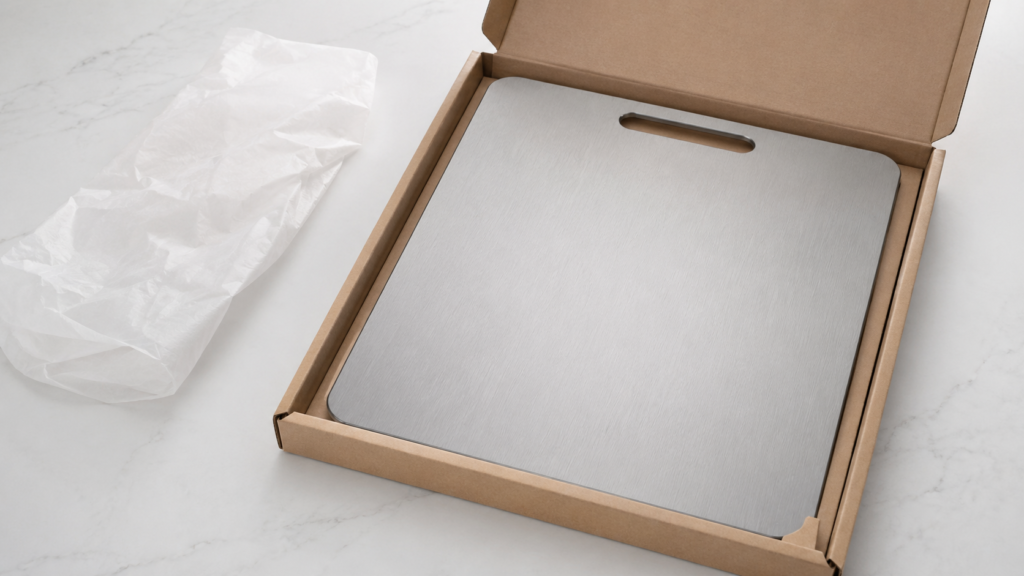
Thank god, the packaging was clean and the board arrives without any protective film residue or surface marks. It definitely gave us a small tho meaningful first signal about quality control.
The finish quality on the Good Artificer Titanium Cutting Board is consistent across the surface with no visible machining marks or uneven sections. The edges are finished smoothly with no sharp corners. It matters more than it sounds when you are picking up and repositioning a board throughout a cooking session.
Thickness sits at around 6mm. It is more substantial than most plastic boards but thinner than a wood end-grain board of comparable size. In hand, it feels more premium than the spec sheet suggests.
The weight is noticeable tho not burdensome, and compared to a standard plastic board of the same dimensions, it feels meaningfully more serious as a kitchen tool.
The surface has a satin appearance instead of a mirror finish, which handles fingerprints and light marks better than a polished surface would. On the counter, it looks current and considered.
How We Tested the Good Artificer Titanium Cutting Board
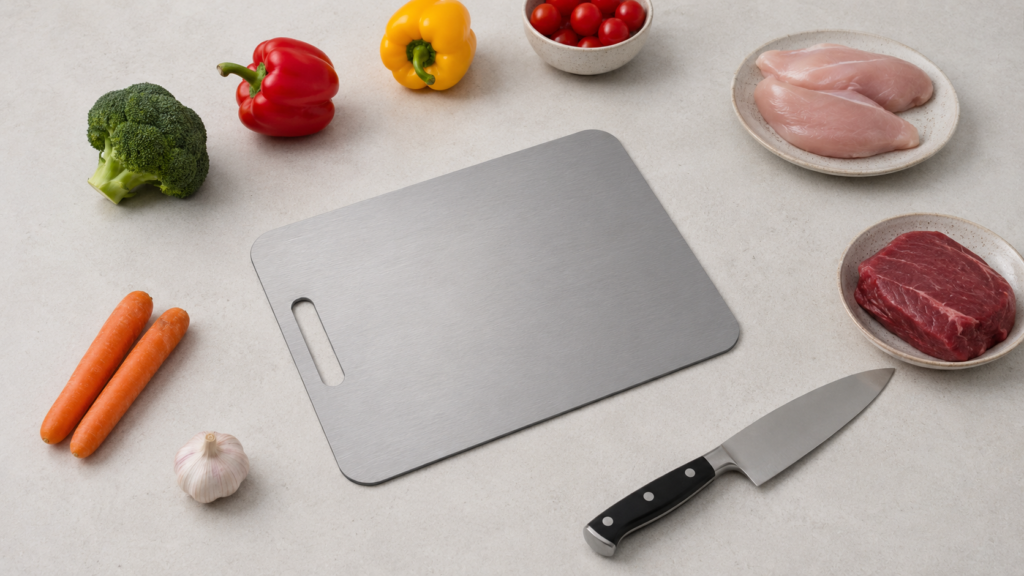
Over several weeks of daily cooking, we ran the board through a full range of tasks. Vegetables covered onions, carrots, bell peppers, sweet potatoes, and leafy greens. Fruit work included pineapple, mango, and citrus. Raw meat testing covered chicken breasts, beef steak, and ground beef preparation. We also used it for bread slicing to assess how it handled the lateral sawing motion of a serrated knife versus the straight-down chopping of a chef’s knife.
What we evaluated across all of those tasks: cutting surface feel and feedback, stability on a granite countertop, cleaning ease after both raw protein and acidic fruit contact, odor absorption after repeated use, and observable impact on knife edges over the full testing period. Every assessment was based on actual use rather than controlled lab conditions, which is the context most buyers are actually purchasing for.
Real-World Performance
Cutting Vegetables and Fruits
The surface feel during chopping is noticeably different from both wood and plastic. There is less give in the surface than wood provides and the feedback through the knife handle is harder and more immediate.
Most of the chopping sessions felt fine once adjusted to that feedback, but cooks transitioning from a quality wood board may need a session or two before it feels natural.
No slipping issues came up during testing. The non-slip base held consistently on a dry granite surface throughout every session, including extended prep work where the board gets repositioned frequently.
One session was conducted without the non-slip base fully engaged and the board moved more than we would have liked, so confirming that the base is making proper contact before starting is a step worth building into the routine.
Cutting Raw Meat
This is where the titanium cutting board made its strongest case. Raw chicken preparation left no staining, no odor after washing, and no visible residue in the surface. The cleanup after raw protein work took under a minute with soap and warm water.
A wood board in the same situation requires more thorough scrubbing to reach into the grain, and a deeply grooved plastic board holds pink residue in the knife marks regardless of how long you wash it.
Stability and Noise
Stability on the counter was reliable with the non-slip base properly positioned. The noise during use is the element most likely to catch new users off guard. Chopping on titanium produces a harder, more metallic sound than wood or plastic, and while it is not loud in any meaningful sense, it registers differently and some users will find it less satisfying than the quieter thud of a wood board. After a week of daily use we stopped noticing it, but it is worth knowing about before the first session.
Is It Really More Hygienic Than Wood or Plastic?
The non-porous surface is the titanium cutting board category’s strongest selling point, and it holds up under practical use. After weeks of regular raw meat preparation with no dedicated sanitizing beyond standard dish soap washing, no persistent odors developed in the surface. A plastic board used for the same period and washed the same way retains a faint protein smell that accumulates in the knife grooves. The titanium board does not develop that over time.
Dishwasher performance across multiple wash cycles produced no warping, no surface discoloration, and no degradation of the non-slip base. The board comes out of the dishwasher looking the same as it went in, which is not something that can be said for quality wood boards that require hand washing and oiling to maintain their surface integrity.
For cross-contamination prevention, the ability to wipe down and sanitize the surface between raw protein and vegetable work in the same session is a genuine practical advantage. The non-porous surface means sanitizer reaches everything rather than sitting on top of a wood grain that partially blocks penetration.
Does the Good Artificer Titanium Cutting Board Damage Knives?
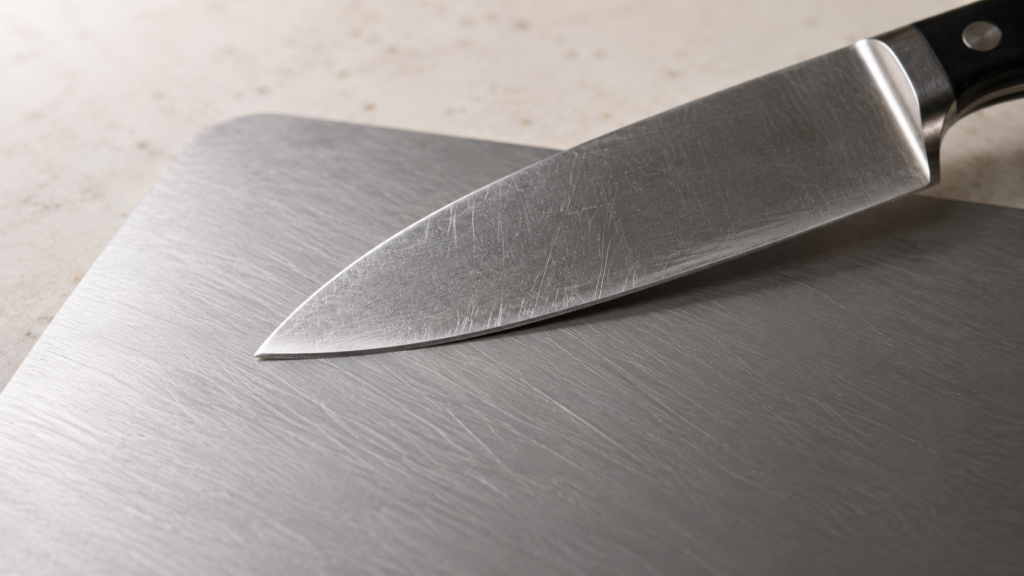
This is the most contested aspect of the titanium cutting board category and we took it seriously during testing. We used a mid-range German chef’s knife and a higher-end Japanese gyuto across the full testing period and assessed edge retention by feel and by checking the edge under light at regular intervals.
The German knife showed no observable edge degradation beyond what normal use across any hard surface produces. The Japanese knife, which starts with a thinner and harder edge geometry, showed slightly more wear than it would have on a quality wood board over the same period. This is not surprising. The titanium surface is harder than wood and provides less cushioning on the edge at the point of contact.
The board itself showed surface marks from both knives. The marks were shallow and did not develop into deep grooves that would compromise the hygiene advantages over time, but they are visible under direct light after extended use. The titanium cutting board is not truly scratch-proof in everyday kitchen conditions regardless of what the marketing states. What it is, is scratch-resistant, meaning the marks stay superficial rather than developing into channels.
Cleaning and Maintenance
Daily cleaning with dish soap and warm water takes under a minute and leaves the surface clean without residual smell or staining. The dishwasher results were consistently clean across every cycle without any change to surface quality or base adhesion. Long-term care requirements are effectively zero compared to wood boards, which need periodic oiling to maintain their surface and resist cracking. The Good Artificer Titanium Cutting Board requires nothing beyond washing.
Final Verdict
The Good Artificer Titanium Cutting Board does what it claims across the areas that matter most to its target buyer. The hygiene advantage over wood and worn plastic is real and demonstrable in daily use. The cleaning experience is the most straightforward of any board material we have used. The build quality justifies the price range when viewed as a long-term kitchen investment rather than a commodity purchase.
For a hygiene-focused home cook who wants a low-maintenance board that handles daily raw protein work cleanly and lasts for years, the Good Artificer Titanium Cutting Board earns its place on the counter. For the cook who values knife performance above everything else, a quality wood board remains the better fit.