

There’s a particular kind of annoying that comes with sitting at a red light in July, watching your vents blow warm air, then feeling that same system snap ice cold the second you start rolling again.
If car AC blowing cold only while driving is the exact pattern bugging you, you’re not imagining it and you’re definitely not the only one dealing with it. Mechanics hear this complaint constantly, and it almost always traces back to something specific rather than some random glitch nobody can explain.
We’ll break down the real causes behind AC not being cold at idle, how you can narrow down which one fits your car, and when it’s smarter to stop guessing and let a shop hook gauges up to the system.
Why Does Car AC Get Cold While Driving but Warm at Idle?
Your car’s condenser sits right up front, usually just ahead of the radiator, and it needs airflow to shed heat properly. Although you’re driving, air is forced through your engine bay, across the radiator and the AC condenser, the same way wind hits your face out a rolled down window. Sit still at a light and that natural airflow vanishes completely.
The only thing left doing the job at that point is your condenser fan. When that fan is weak, caked in dirt, or just not kicking on the way it should, cooling drops off fast the moment your wheels stop turning.
That’s exactly why so many drivers notice AC cold when driving but warm at idle, and it’s also why this pattern shows up constantly in repair shop diagnostics instead of being some rare complaint nobody’s ever heard of.
7 Reasons Your Car AC Is Cold While Driving but Warm at Stops
A Car AC Blowing Cold only on the road, then turning soft the moment you stop, almost always comes down to one of these seven things.
1. Failing Condenser Cooling Fan
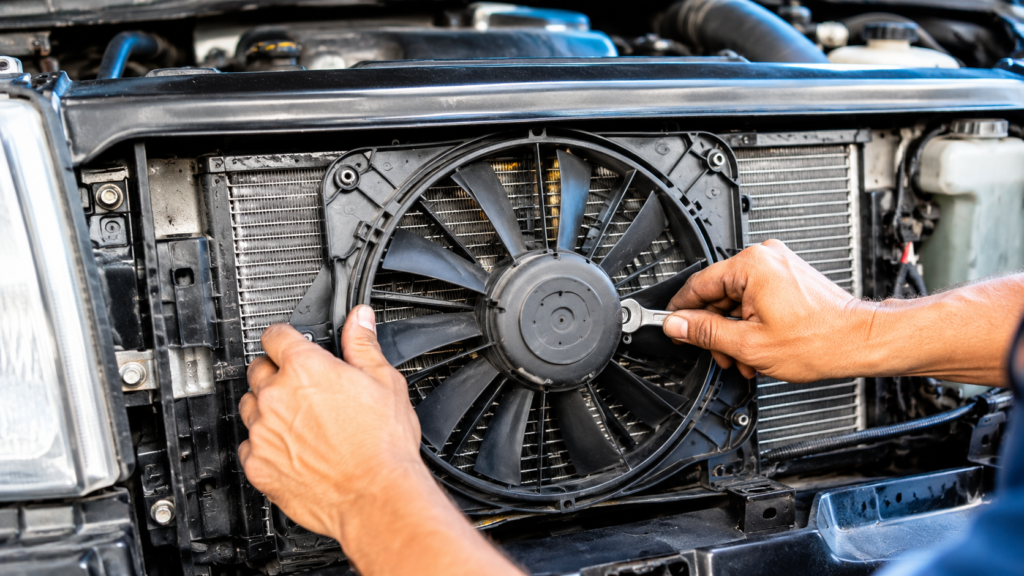
This is the single most common reason behind a car AC cold while driving setup that goes weak or warm the second you stop. The car AC condenser fan mounted behind the radiator is doing the job wind normally handles once your car is actually moving.
If the fan motor is on its way out, a blade’s cracked, or the relay feeding it has failed, the fan either spins too slowly or doesn’t spin at all. Turns out, heat backs up inside the condenser, pressure climbs, and the air coming through your vents turns warm within a minute or two of sitting still. In plenty of cases, the AC works while driving without a single issue, right up until the car rolls to a full stop.
How to Fix It
- Pop the hood while the AC is running and the engine’s idling, then look straight at the fan sitting in front of the radiator. It should be spinning steady and even.
- If it’s barely turning, stuttering, or dead still, check the fuse and relay on that circuit first, since those parts are cheap and take five minutes to test.
- If both check out fine, the fan motor itself is almost certainly the culprit and it’ll need to be swapped.
2. Low Refrigerant or a Refrigerant Leak
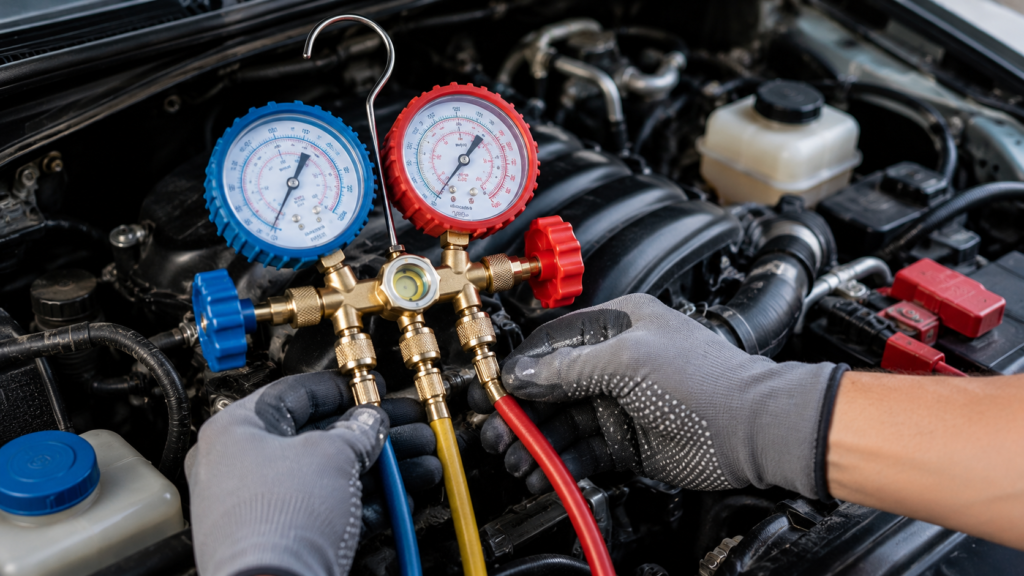
A refrigerant leak slowly starves the whole system of the fluid it needs to actually move heat out of your cabin. Here’s the part that trips a lot of people up though. A genuine refrigerant shortage usually shows up as weak cooling everywhere, not just at idle.
If your system blows genuinely cold air on the highway and only turns warm once you stop, low refrigerant is a less likely explanation on its own, since a low charge tends to hurt performance across the board instead of just at a standstill.
It’s still worth ruling out, especially if cooling has been sliding downhill gradually over weeks or months instead of showing up out of nowhere, cuz classic low refrigerant symptoms include weak cooling at both idle and speed, not just one or the other.
A properly charged R134a system typically runs somewhere around 25 to 45 psi on the low side and 225 to 250 psi on the high side once the engine’s warmed up, and that’s the exact range a technician checks against when they hook up gauges. Numbers well outside that window point straight at a charge problem before anything else gets touched.
How to Fix It
- A shop can hook up gauges and check your system’s AC pressure in a few minutes flat, which tells them right away whether the charge is low.
- If it is, they’ll also run a dye test or an electronic leak check instead of just topping it off, because refrigerant doesn’t just vanish into thin air on its own.
- Adding more without finding where it’s escaping just means doing the whole thing again in a few months.
3. Weak or Failing AC Compressor
Your AC compressor is belt driven off the engine. Turns out, it spins faster as your engine RPM climbs. That’s part of why cooling can genuinely improve once you’re cruising or accelerating hard.
The AC compressor definitely cools quicker when it’s running at higher RPMs, and a compressor that’s starting to wear out, with a slipping clutch or worn internal parts, may struggle to build enough pressure at low RPM but perform closer to normal once engine speed picks up out on the road.
How to Fix It
- Listen for grinding, clicking, or squealing coming from around the compressor when the AC first switches on, particularly right as the clutch engages.
- A mechanic can test clutch engagement and measure output pressure directly to confirm whether the compressor’s actually the weak link before you spend real money replacing it.
4. Dirty or Blocked AC Condenser
Even with a healthy condenser fan, a condenser packed with bugs, road grime, or leaves can’t shed heat the way it’s supposed to. This mostly hurts idle cooling and low speed cooling. That’s exactly when the system leans hardest on the fan pulling air through those blocked fins.
At highway speed, the sheer volume of air forced through the grille can partially push past the buildup, which is another reason a dirty condenser can look a lot like normal cooling on the road paired with poor cooling at a stop.
How to Fix It
- With the engine off, take a look at the condenser through the front grille.
- Caked on dirt, bent fins, or leaves wedged into the core are usually easy enough to spot with a flashlight.
- A gentle rinse with a hose, plus a fin comb for any bent sections, often restores airflow completely.
- Skip the pressure washer at close range though, since it can bend those delicate fins even further and make the whole problem worse.
5. AC Pressure or Control Problem
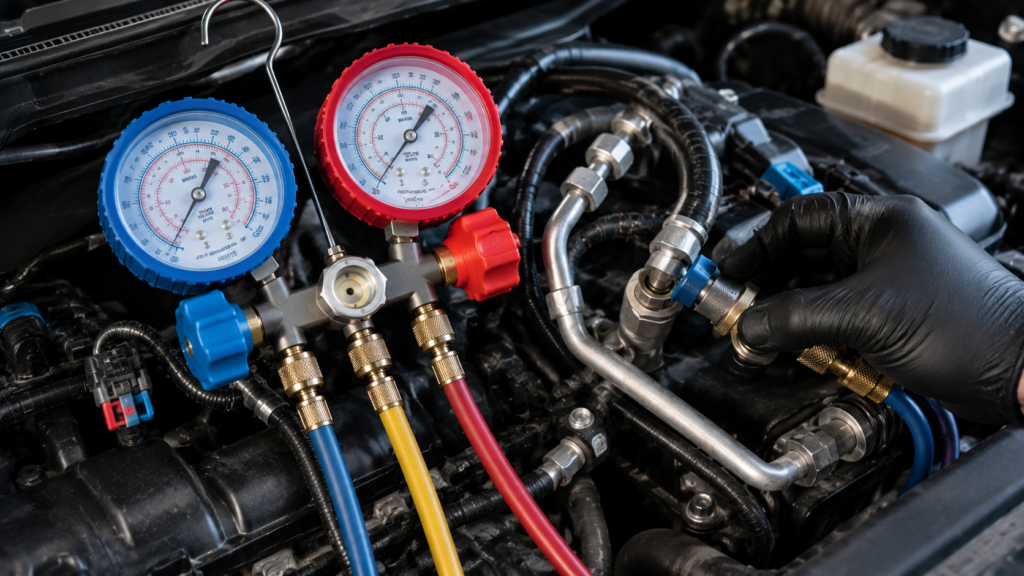
Modern AC systems lean on pressure switches and sensors to decide when the compressor clutch should engage and when the cooling fans should kick on. If one of those switches is reading wrong, it can cut the compressor off, or fail to trigger the fan at idle, even though the system otherwise has enough refrigerant and a compressor that works fine.
How to Fix It
- This one usually needs a scan tool or a manual gauge set to check actual system pressure against what the sensor claims it’s reading.
- A mismatch between the two points toward a bad sensor or a wiring issue instead of a mechanical failure, and that changes the entire repair path from there.
6. Restricted Airflow Inside the Cabin
Not every complaint about warm air is really about AC cooling at all. Sometimes a driver describes it as their car AC blows warm at idle, but the system’s actually cooling the air just fine and not enough of that cooled air is making it to the vents.
Quick Clue
- Strong airflow paired with warm air points toward the cooling or refrigerant side of things and is worth chasing down first.
- Weak airflow, even if the air feels somewhat cool, points toward the cabin filter, the blower motor, or the broader HVAC airflow path instead.
7. Blend Door or HVAC Control Problem
The blend door controls how much air passes over the heater core before it ever reaches your vents. If that door gets stuck partway open because of a broken actuator or a snapped linkage, warm air can mix into your vents no matter how well the AC system itself is running. And this often gets worse or more noticeable at idle when overall airflow through the vents slows down.
How to Fix It
- Listen for a clicking or tapping sound from behind the dashboard when you adjust the temperature dial, which is a classic sign of a failing blend door actuator.
- A mechanic can access and test the actuator directly, and replacement is usually a dashboard level repair rather than anything happening under the hood.
What Is the Most Likely Fix?
Matching your exact symptom to a probable cause narrows things down fast, though. It’s worth saying plainly that a symptom points you in a direction, it doesn’t confirm which single part actually failed.
A driver describing car AC not cooling at stop and a driver describing weak cooling everywhere are usually staring at two completely different repairs, even though both technically involve AC pressure somewhere along the diagnosis.
| Symptom | Possible Cause | Likely Direction |
|---|---|---|
| Cold driving, warm at stops | Condenser fan | Check fan operation |
| Cold driving, weak at idle | Low refrigerant | Leak or charge diagnosis |
| Cold only at higher RPM | Weak compressor | Compressor testing |
| Poor cooling everywhere | Refrigerant, compressor, or other fault | Full AC diagnosis |
| Weak airflow | Cabin filter or blower | Check airflow system |
| Fan runs but cooling remains poor | Refrigerant, condenser, or compressor | Pressure and performance testing |
One clue worth paying attention to on your own is your temperature gauge. Take the car out for a short drive and monitor your temperature gauge while you do it.
Does the gauge rise toward hot at the same time the AC begins to blow warm air? If it does, I don’t believe it’s a refrigerant issue at that point. It sounds more like the vehicle is overheating, possibly due to a stuck open thermostat, and that’s a scenario that’s probably less likely while driving compared to when it’s stationary. In this scenario, airflow across the radiator is stronger on the move.
A faulty condenser fan or a clogged condenser can cause overheating too, and that reduces cooling efficiency at speed as much as it does at a stop. It is indeed part of why a mechanic will often check both the cooling system and the AC circuit together rather than treating them as separate problems.
Should You Recharge the AC Yourself?
A cheap can of refrigerant from the auto parts store feels like the fastest fix, though it can mask a leak instead of solving it, and overcharging a system is a common way to damage the compressor outright.
There’s also a legal side to this most drivers never hear about. Under EPA rules tied to the Clean Air Act, intentionally releasing automotive refrigerant into the air during service work isn’t permitted
Turns out, anyone servicing vehicle AC systems for a living has to be certified to handle it properly. None of that changes just because your particular car AC cold while driving complaint feels minor.
If your system’s genuinely low, a shop visit that includes a real leak check is worth a lot more than a can and a hope. This is also why a simple AC repair at idle diagnosis, checking the fan and pressure readings before touching the charge at all, tends to save money over guessing first and hoping for the best.
Most of the time, Car AC Blowing Cold only while you’re on the move points to something a shop can diagnose quickly rather than an expensive mystery, but a few situations genuinely call for a professional look.
When Should You Take the Car to a Mechanic?

- AC stops cooling completely, in any condition
- The compressor makes grinding, squealing, or clicking noises
- The cooling fan won’t turn on at all
- You suspect a refrigerant leak based on gradually worsening cooling
- Cooling cuts in and out unpredictably instead of staying consistent
- Your engine temperature gauge starts climbing
- You notice an electrical burning smell or any other unusual symptom
A technician will also confirm the system is properly charged with 134A refrigerant and that all electrical connections to the compressor clutch and fans are secure, cuz a loose connection alone can mimic half the symptoms on this list.
Frequently Asked Questions
Can a bad condenser fan cause AC to stop cooling at idle?
Yes, and it’s one of the most common causes of AC not cold at idle as a complaint. Without airflow from a working AC fan, the condenser can’t release heat once your car stops moving, and idle cooling depends almost entirely on that fan doing its job right.
Should I recharge my AC if it gets cold on the highway?
Not right away. A car AC cold while driving pattern paired with warm air at idle usually points toward a fan or airflow issue instead of a low charge, so recharging first often treats the wrong problem entirely.
How do I know if my AC compressor is failing?
Listen for unusual noise when the clutch engages, and pay attention to whether cooling seems to improve as engine RPM climbs, which is a classic sign among bad AC compressor symptoms worth flagging early.
Why does my AC get colder when I accelerate?
Higher RPM spins the belt driven compressor faster, moving more refrigerant through the system, which is completely normal and part of why AC cooling at highway speed often feels stronger than it does sitting still at a light.
Wrapping Up…
A car AC cold while driving situation, blowing genuinely cold air at speed but only managing to blow slightly cool air the moment you stop, is rarely random. It almost always traces back to airflow across the condenser, a fan that’s not pulling its weight, or occasionally a compressor struggling at low RPM.
Walking through the checks in this guide, starting with the condenser fan and working through refrigerant, airflow, and the blend door, will get most drivers to a clear answer for their Car AC Blowing Cold only complaint without much guesswork involved.
When the cause stays unclear, or the symptoms start pointing toward something electrical or pressure related, a proper diagnosis with actual gauges beats another can of refrigerant every single time.