
Finding a reliable dash cam takes more research than most people expect. We went through Reddit threads on r/dashcam, dug into Quora discussions, watched comparison videos, and read through customer feedback across multiple platforms before making a call. We needed something that actually captures readable license plates at night, handles parking surveillance reliably, and does not fail when summer heat turns the inside of a car into an oven.
The VIOFO A229 Plus Dash Cam kept appearing as the answer across every source we checked. We bought one, installed it ourselves, and drove with it specifically to stress-test the claims. This VIOFO A229 Plus Dash Cam Review covers the full experience from unboxing through several months of real road use.
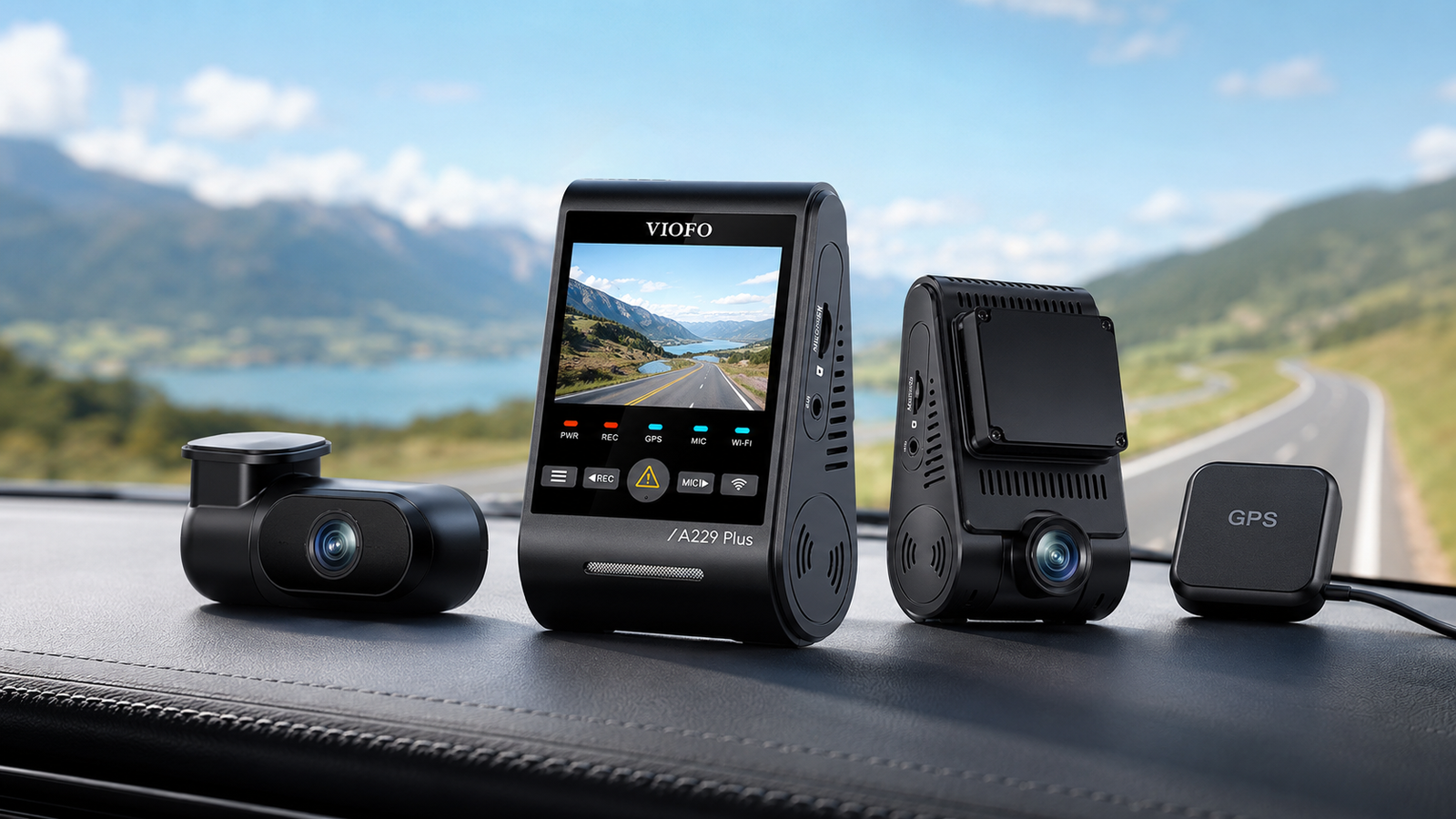
VIOFO A229 Plus at a Glance
- Video Resolution: 2K front, 1080P rear
- Field of View: 140 degrees
- Connectivity: 5GHz WiFi, GPS module included
- Dimensions: 1.7 x 2.3 x 3.9 inches
- Voice Control: 12 commands supported
- Storage: MicroSD, up to 256GB
- HDR Recording: Dual-Channel HDR
- Vehicles: Car, truck, SUV, minivan, RV, bus
- Sensors: Sony STARVIS 2 IMX675 on both front and rear

What Is Included in the Box
- Front and rear camera unit
- Rear cable at 6 metres
- Car charger at 3.5 metres
- Two static windshield stickers
- Two 3M adhesive mounts
- Rear mount bracket
- Trim removal tool
- GPS module with mounting sticker
How We Tested the VIOFO A229 Plus Dash Cam
Video Quality Test
The first dedicated test run happened at 10:30 PM. We drove a planned city and county route with one specific goal in mind. Does license plate capture work under real nighttime road conditions? That test matters more to us than any spec sheet number because the whole point of a dash cam is documentation when something goes wrong, and if you cannot read a plate in the footage, the recording is largely useless for anything that matters.
Night Vision Performance
What the Sony STARVIS 2 IMX675 sensors do at night is genuinely different from what standard dash cam sensors produce. The STARVIS 2 generation delivers 2.5 times the dynamic range and 2.5 times the light sensitivity of the original STARVIS sensor.
In practice, that translates to footage where plates on vehicles within roughly 10 feet are clearly legible without any post-processing or frame manipulation. We checked footage after the night drive and could read every plate in that range cleanly.
One habit we picked up from this. We now read plates aloud as they come into range during any unusual situation on the road. The audio recording captures the voice track alongside the video, which doubles the documentation value of any incident where a vehicle pulls away before you can write anything down.
The glare on both cameras was minimal throughout the night session. The one visual note worth flagging is that a bright interior dashboard display will show up as a reflection in the front footage. These sensors capture everything at that sensitivity level. It is the trade-off for having exceptional low-light capability.
HDR Performance
Dual-Channel HDR handles the contrast situations that expose the limits of basic dash cam sensors. The moment a tunnel entrance appears against bright daylight, morning sun directly in the lens, and shaded road surfaces against a bright sky.
Throughout our testing across different times of day and weather conditions, the footage held detail in both the highlight and shadow areas without the washed-out bright zones or crushed shadow areas that single-channel systems typically produce.
Daytime Footage
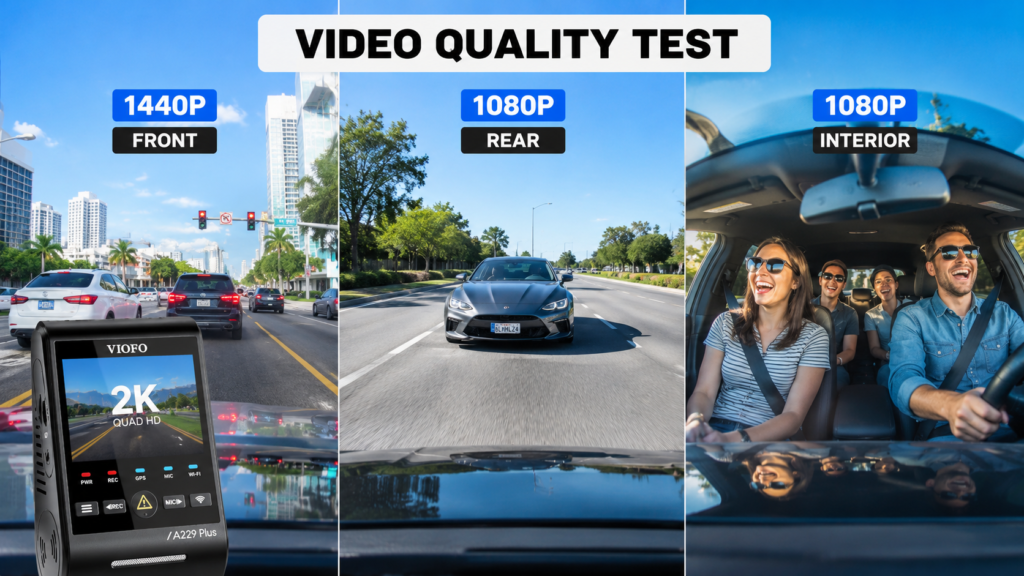
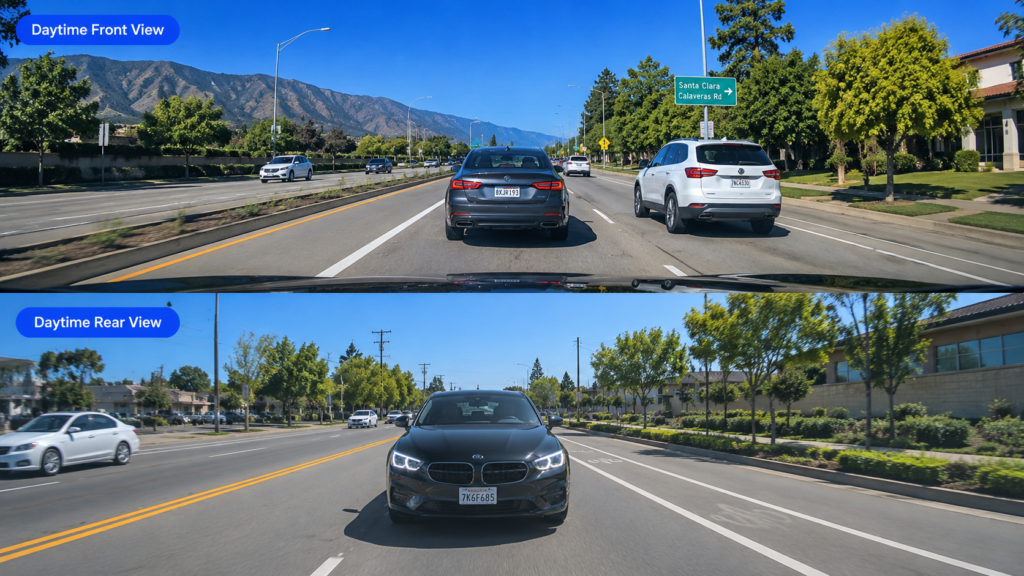
Daytime 2K front and 1080P rear footage is clean and sharp at both standard and maximum bitrate settings. After upgrading to a 256GB card, we ran both cameras at maximum quality simultaneously and logged around 12 hours of continuous footage before needing to clear anything. The compression held up well at longer recording durations without visible quality degradation.
Voice Commands and Notifications
It comes up with 12 voice commands you could use while you drive. It includes locking a clip, taking a still photo, activating WiFi, switching the display between front and rear feeds, and acknowledging system notifications for settings changes or card errors. My feature is the ability to switch between front and rear feed with just a command. The recognition works at normal conversation volume in a car cabin without requiring a raised voice or repeated attempts under most conditions.
Time-Lapse and Parking Mode
It has three parking mode configurations and each one has different use case. Auto Event Detection for impact-triggered recording, a buffered recording function that captures footage before the trigger event, and Time-Lapse at low bitrate for extended surveillance sessions without consuming significant storage.
The 24/7 coverage setup requires hardwiring to a constant 12V source, an accessory 12V source, and a ground connection. If parking coverage is not a priority, driving-mode-only installation is considerably simpler.
Installation Experience
Front-camera-only installation with the included car charger takes under 15 minutes. Adding the rear camera means running a single USB-C cable from the main unit to the rear mount, tucked behind interior trim using the included tool. The trim tool quality was noticeably better than expected, on par with a decent dedicated tool from an auto parts store.
We recommend two things here before you mount.
- Place the unit far enough from the rearview mirror that the MicroSD card slot stays accessible after the mount is set.
- The 3M adhesive these units use is extremely strong. Taking the unit off without preparation means spending significant time removing adhesive residue from the camera body with isopropyl alcohol. An extra 3M sticker comes in the box, which saves the situation if the first mount position needs adjustment.
Getting the rear cable behind the trim paneling takes patience the first time through. Once the right angle for fitting past airbag slot edges and plastic panel seams becomes clear, it moves quickly. Total installation on our SUV ran about 25 minutes for the full hardwired dual-camera setup.
App and Connectivity
The 5GHz WiFi module connects faster and holds more stable than 2.4GHz alternatives common in older dash cams. File transfers through the app are functional tho not instant for longer clips.
Pulling the card directly is faster when you need multiple files. For grabbing a specific locked incident clip, the app transfer speed is workable. We set loop recording to 2-minute segments, which keeps individual file sizes manageable and makes locating specific moments in the timeline faster.
Temperature Durability
This was the deciding factor in the purchase decision more than any other single specification. I’ll tell you why. Dash cameras fail from heat and condensation before almost anything else could create a concern,
Most budget car dash cams use standard capacitors that are not built for the temperature swings. VIOFO uses temperature-selected capacitors and electrical components specifically to handle extreme heat, freezing, condensation, and full direct sunlight exposure. So no matter where you live, whether in California or Alaska (lol), the dash cam will keep working.
We reached out to VIOFO customer support before we ran into any problem, just to confirm support was accessible. The response was prompt and covered every question in detail, which gave us confidence in the brand beyond the hardware itself.
What We Like
- Excellent Night Vision
- Dual STARVIS 2 Sensors
- Reliable HDR Recording
- Responsive Voice Control
- Heat-Resistant Components
- 256GB Storage Support
- Extra Adhesive Mount
- Clear Audio Recording
What We Don’t Like
- Screen Reflection Issues
- Difficult Mount Removal
Is the VIOFO A229 Plus Worth Buying in 2026?
Is VIOFO A229 Plus Worth Buying in 2026 for someone who wants reliable documentation on the road? The hardware answers that question clearly. The VIOFO A229 Plus Dash Cam produces nighttime footage where license plates are actually readable, which separates it from a large portion of the competition, regardless of what the spec sheets say. We caught ours during a flash sale at $159, although it is still selling at $159, so you can grab it.
Wrapping Up…
The VIOFO A229 Plus Dash Cam is a well-built dual-channel camera with sensors that produce footage worth actually keeping. Mount it with the card slot accessible, run a 256GB high-endurance card, and the system covers everything a driver needs from on-road documentation through parked surveillance without requiring ongoing adjustment or attention. After several months of daily use across city and highway conditions, nothing has given us a reason to question the purchase.
Frequently Asked Questions (FAQs)
Does the VIOFO A229 Plus record in 4K?
The front camera records at 2K resolution at up to 60fps, with the rear running 1080P. The 2K decision is a practical one. The resolution delivers everything needed for license plate and incident documentation without the storage demand that 4K creates. On a 256GB card at maximum dual-channel settings, around 12 hours of footage is available before any files need clearing.
Is the VIOFO A229 Plus good for night driving?
Night driving performance is where this camera separates itself from most alternatives at this price point. The Sony STARVIS 2 IMX675 sensors produce footage where plates on nearby vehicles are legible without post-processing. That outcome is the direct result of the 2.5 times light sensitivity improvement over the original STARVIS generation and it shows clearly in real road conditions after dark.
Does the VIOFO A229 Plus include a memory card?
No card is included in the box. A 256GB high-endurance MicroSD card is the practical starting point based on our experience. A 16GB card fills in roughly two hours at moderate quality settings, which makes it inadequate for any serious use case.
How much storage does the VIOFO A229 Plus support?
The unit supports MicroSD cards up to 256GB. Running maximum quality on both front and rear cameras simultaneously with loop recording active, a 256GB card holds approximately 12 hours of continuous dual-channel footage before the oldest segments begin overwriting.